
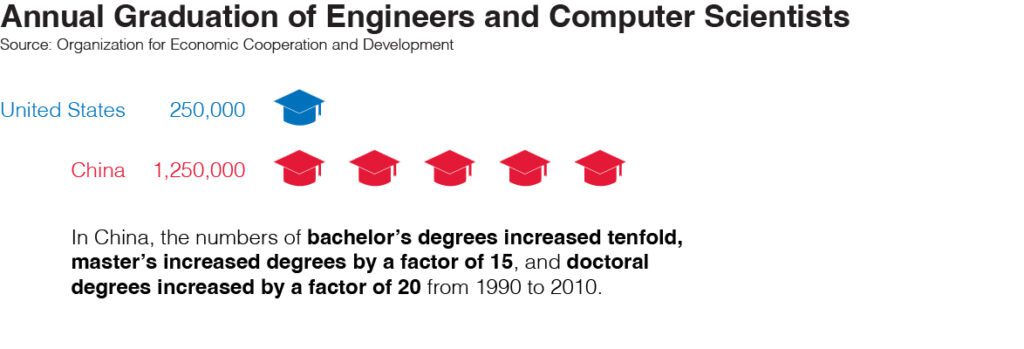
The numbers tell a stark story: China now graduates roughly 1.25 million engineers
and computer scientists annually—five times the U.S. total of 250,000. Over just two
decades, China’s output of bachelor’s degrees in these fields increased tenfold,
master’s degrees by 15 times, and doctorates by 20 times. Meanwhile, U.S. growth
has been comparatively modest, widening the domestic gap in the talent needed to
fuel the innovation economy.
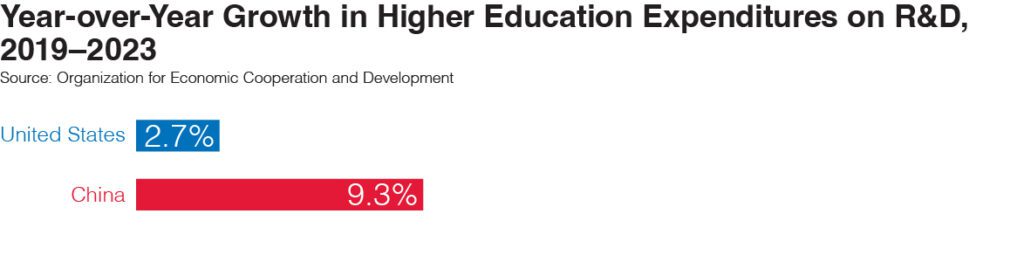
The trend is echoed in research investment. From 2019 to 2023, China’s higher
education R&D spending grew by 9.3 percent annually, more than three times the
pace of the U.S.’s 2.7 percent growth. These figures reflect a deliberate, long-term
strategy: China is not just producing talent; it is equipping universities and research
institutions to scale technology development faster and more efficiently.
What are the implications for the United States? The data reflect key findings from
our report, Competing in the Next Economy: Innovating in the Age of
Disruption and Discontinuity: our global leadership in emerging technologies—
from AI and advanced manufacturing to biotechnology—depends on both skilled
talent and robust (largely higher education-based) research infrastructure. Without
stronger investment in STEM education, infrastructure, and technology deployment,
the United States risks ceding critical ground in fields that will define economic and
national security competitiveness for decades to come.
There are actionable paths forward. While it may be difficult to win purely on
numbers of graduates, strengthening regional innovation ecosystems, reversing the
structural decline of federally funded research, expanding access to cutting-edge
facilities, and accelerating the scaling of critical technologies — all
recommendations and many more articulated in the Council’s Competing in the Next
Economy roadmap report — can help ensure the United States retains its
competitive position. But with China’s surge in graduates, R&D investment, and
industrial deployment, how will the United States respond?