
Reflections from the Global Federation of Competitiveness Board Council Meeting at the University of Pittsburgh
When I stood before the global federation of competitiveness leaders gathered at University of Pittsburgh last month, I opened with three numbers that frame our current reality:
One trillion dollars in global AI infrastructure investment over the next two years. Thirty four percent revenue growth for U.S. companies deploying AI at scale. And 5,426 data centers powering America’s digital economy, more than ten times China’s public count.
These aren’t just statistics. They’re signals of a fundamental transformation: artificial intelligence has evolved from an emerging technology into the foundation of our economic and national security infrastructure. The question before us is no longer whether AI matters, but whether America will maintain the leadership position we’ve fought so hard to build.
The Leadership We’ve Earned and Can’t Take for Granted
American innovation built the AI revolution. Our research universities pioneered the foundational breakthroughs. Our venture capital ecosystem funded the risk-taking that turned laboratory concepts into world-changing products. Our open culture attracted the global talent that made Silicon Valley synonymous with technological leadership.
The results speak for themselves. The United States continues to produce the majority of the world’s foundation models. Our companies are deploying AI faster and more effectively than competitors anywhere else, generating substantial revenue rather than just proof of concepts. We’ve built a data center infrastructure at unprecedented scale, driven by computing demands from Microsoft, Google, Meta, NVIDIA, and a dynamic new generation of AI native startups.
But leadership in technology, like leadership in any competitive arena, is never permanent. China is mobilizing state resources toward AI dominance. European regulators are working to set global standards. Gulf nations are deploying sovereign wealth at trillion dollar scale. The competitive landscape has never been more intense or the stakes higher.
The Next Wave: From Generative AI to Autonomous Intelligence to Physical AI
The generative AI tools that captured the world’s attention over the past two years represent just the beginning of an even more transformative phase of technology; the rise of Agentic Artificial Intelligence.
Agentic AI is an autonomous system capable of long-term planning, complex decision-making, and independent execution across organizational systems. These aren’t chatbots or content generators. They’re digital colleagues that can reason, strategize, and act with minimal human supervision.
Simultaneously, physical AI is moving from research labs into real-world deployment. Humanoid robots are beginning to work alongside humans on factory floors. Autonomous systems are being piloted in healthcare settings. Advanced aerial platforms are being integrated into defense architectures.
This all sets us upon a horizon of artificial general intelligence systems approaching human level problem solving capabilities across diverse domains.
These technologies aren’t science fiction, but in active development and early deployment right now, in manufacturing facilities, logistics networks, defense installations, and medical centers. The nations and companies that master these capabilities won’t just capture market share. They’ll define the future of productivity, economic growth, and strategic advantage.
A Blueprint for Sustained American Leadership
Maintaining American leadership requires more than momentum. It demands deliberate strategy and coordinated action across seven critical areas:
- Declare AI a National Priority - We need the clarity of purpose that characterized the Apollo program: a commitment to technological leadership that aligns public and private sector efforts toward shared goals with both economic and security dimensions.
- Accelerate Infrastructure Development - Data centers and energy infrastructure are the railroads and highways of the AI era. We must streamline permitting processes, unlock land access, and build reliable power systems that can support exponentially growing computational demands.
- Modernize Regulatory Frameworks - Innovation operates at venture speed while government traditionally operates at bureaucratic pace. We need regulatory approaches that protect important values while enabling the experimentation and rapid iteration that characterize American competitiveness.
- Lead Through Open Development - American leadership should be built on transparent, accountable AI systems that embody democratic values. Open source models developed under American leadership can set global standards for capability, safety, and ethical alignment, providing a values based alternative to closed authoritarian approaches.
- Invest in Workforce and Security Integration - The AI infrastructure must be built with American workers, creating high quality jobs across the country. Simultaneously, we must integrate AI capabilities thoughtfully into defense, manufacturing, and cybersecurity systems to maintain strategic advantages.
- Strengthen Democratic Technology Alliances - /.//Our allies and partners need access to secure, trustworthy AI infrastructure. By providing capable alternatives to authoritarian technology exports, we can help ensure that democratic values shape the global technology landscape.
- Address Risks Proactively - From deepfakes to workforce disruption, AI introduces real challenges that demand serious attention. Leading responsibly means confronting these issues head on, with speed and sophistication rather than avoidance or overreaction.
Two Paths Forward
The choices we make in the next several years will determine which of two very different futures emerges.
In one future, America leads a global AI ecosystem characterized by openness, innovation, economic opportunity, and democratic accountability. In this future, AI development accelerates human potential, creates broadly shared prosperity, and reinforces the values that have made American technology leadership a force for global good.
In the alternative future, we cede leadership to competitors whose AI systems reflect different values: systems built on surveillance, control, and restricted access to information and opportunity.
This isn’t about market share alone. It’s about whose values shape the technology that will mediate human communication, work, creativity, and decision making for billions of people. It’s about whether the infrastructure of the digital age reinforces freedom or constrains it.
The Moment Demands Action
The conversation at University of Pittsburgh brought together the exact coalition we need. The room was alive with business leaders who understand market dynamics, technologists who grasp capabilities and limitations, investors who can deploy capital at scale, and policymakers who can create enabling environments.
What we need now is the courage to act with urgency. Energy infrastructure that can support massive computational growth. Permitting reforms that measure timelines in months rather than years. Alliance structures built on trust and shared interests. And the determination to confront difficult tradeoffs rather than deferring them to future generations.
Our Generation’s Defining Challenge
Every generation faces a moment that defines its legacy. For ours, that moment has arrived.
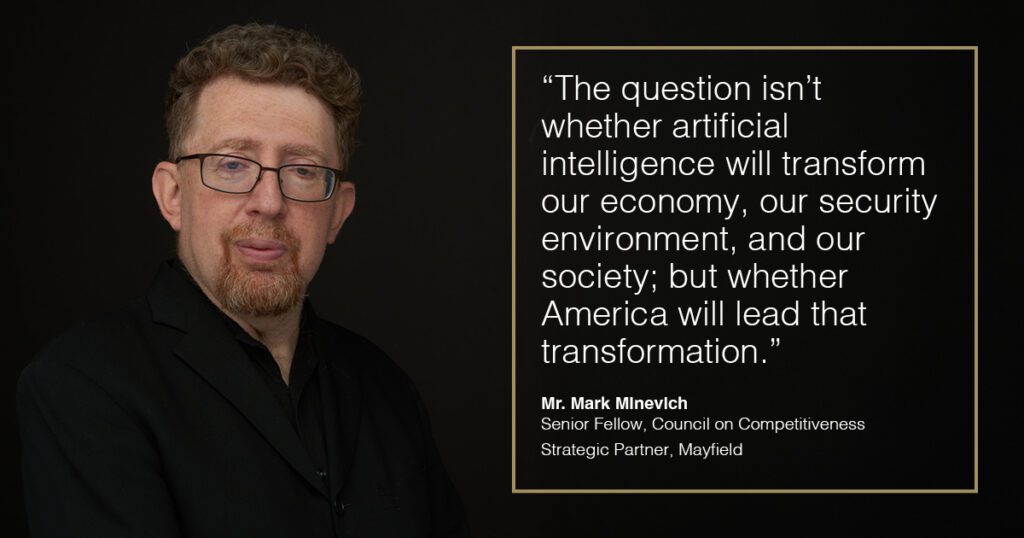
The question isn’t whether artificial intelligence will transform our economy, our security environment, and our society, but whether America will lead that transformation. We must be the ones building the infrastructure, driving the innovation, and forging the partnerships that ensure AI development reflects our values and serves our interests.
History will remember who had the vision and the will to act decisively when it mattered most.
The race is on. It will be our work that ensures America wins it.
About the Author
Mark Minevich is a Senior Fellow at the U.S. Council on Competitiveness and Global Federation of Competitiveness Councils, Strategic Partner at Mayfield Fund, and President of Going Global Ventures. He serves as a United Nations Advisor, listed in top 100 AI influencers and leaders globally, and is the author of “Our Planet Powered by AI” (Wiley). The views expressed are his own.