
Global economic and geopolitical uncertainty is no longer episodic; it has become structural.
Non-financial U.S. corporations are holding approximately $7.9 trillion in liquid assets — roughly 12 percent of their total — a level that reflects elevated interest rates and heightened risk sensitivity rather than capital scarcity.1
At the same time, traditional pathways for deploying and recycling capital have become more challenging. Global M&A activity fell to roughly $3.2 trillion in 2023, the lowest level in about a decade, with only modest stabilization in 2024 and into 2025.2 Liquidity events are less frequent, valuations are more constrained, and exits take longer to materialize.
From my experience, and backed up by the experiences and challenges faced by the senior executives with whom I have been meeting, I see three themes central to the success of business operations in 2026: (1) a new commercialism in how organizations engage customers, (2) evolving approaches to funding and capital structures, and (3) the availability and usability of data in an AI-driven economy. These themes cut across sectors and geographies and collectively signal where competitive advantages can be built by focusing on — and in many cases retooling — the core operational fundamentals of a business.
1. A New Commercialism: Evolving Consumer Behavior and Experience
Over the past quarter-century, consumer behavior has decisively broken from legacy models. Digital channels now dominate discovery, comparison, and increasingly, transaction itself. Across the United States in 2001, e-commerce accounted for only 1.1 percent of total retail sales, rising relatively steadily to 16.3 percent by mid-2025 on a seasonally adjusted basis.3 This share represents a permanent reordering of how consumers interact with markets.
What matters more than the percentage is what it signals: consumers expect speed, transparency, and autonomy in early interactions with companies and products. Routine needs are increasingly resolved through self-directed digital channels, while human expertise is reserved for moments of complexity and risk. Customer experience and expediency now frequently outweigh traditional credentials at the front end of the customer journey.
Healthcare provides a clear illustration. While the convenience of telehealth (which ballooned during the pandemic) seems self-explanatory, a trend was growing well before this in a shift away from ivory tower institutions to the convenience of walk-in clinics. Virtual and convenience care have become normalized for routine, behavioral, and follow-up services, while in-person care at major institutions has shifted toward moments that require physical presence or are of higher medical severity.
Retail and professional services show the same pattern. Customers increasingly arrive at physical locations having already conducted extensive independent research. Stores and offices are no longer the starting point of the journey; they are points of confirmation, service, or escalation. Organizations that reimagine their core business processes to align their resources to the modern buyer journey will establish a competitive advantage over rivals.
2. Financing Models: Redefining Growth and Resilience
Just as customer behavior has shifted, so too has the capital environment. The era of near-zero interest rates and frictionless financing has ended; capital is no longer cheap nor patient.
The consequences are visible across investment and exit markets. Venture funding and IPO activity fell sharply from their 2021 peaks and remained well below historical averages through 2023 and 2024.4 Exit timelines have lengthened, valuation multiples have compressed, and capital allocation decisions are being scrutinized more closely. Organizations can no longer rely on market momentum to compensate for weak fundamentals.
At the same time, a deeper structural shift is reshaping how innovation is financed. Federally funded research in the United States has declined from nearly 1.9 percent of GDP in the 1960s to roughly 0.6 percent by 2023, with the federal share of total R&D now accounting for less than one-fifth of total national investment.5 Innovation risk has steadily migrated from the public sector to private firms, universities, philanthropies, and mission-driven organizations.
This backdrop presents an opportunity to innovate around hybrid funding models. Public-private partnerships, collaborations, and business models that integrate for-profit and nonprofit entities and blended capital structures are a future opportunity to finance long-horizon initiatives that struggle to fit within traditional return profiles. These arrangements allow organizations to share risk, access new pools of capital, and pursue strategic investments that would otherwise remain underfunded.
The most resilient organizations will not simply be cutting costs or waiting for capital markets to rebound. They are redesigning their capital strategies — diversifying funding sources, aligning investment horizons with strategic objectives, and prioritizing pathways to durable cash flow over speculative exits. In an environment where liquidity can no longer be assumed, these strategies can also be a differentiator.
3. Data and AI: From Readiness to Results
Artificial intelligence has moved rapidly from experimentation to expectation. The limiting factor is rarely the technology itself. Peer-reviewed research consistently shows that data quality, governance, and organizational readiness are the primary constraints on successful AI deployment, often outweighing algorithmic sophistication. Fragmented data, inconsistent definitions, and legacy architecture continue to prevent many organizations from scaling AI beyond isolated pilots.
The result is a familiar pattern that has been seen across eras — whether web adoption in the 1990s or mobile devices in the early aughts: initial enthusiasm but with business applications only at the edges and only modest operational impact. For many organizations, the foundational work necessary to fully transform businesses remains incomplete. Core processes still need digitization, data assets must be consolidated and structured, and governance frameworks must address privacy, security, and accountability. Without this groundwork, AI initiatives risk becoming expensive demonstrations rather than engines of productivity enhancement.
Organizations that are excelling take a different approach. They begin not with tools, but with intent, clearly defining where AI should create value — whether in customer experience, operational efficiency, or innovation velocity — then architecting the organization’s data systems around this purpose. Data strategy, talent development, and governance are then aligned to that objective, which gives way to subsequent AI innovation. In these cases, AI becomes a catalyst for operating-model transformation rather than a standalone technology experiment.
Conclusion
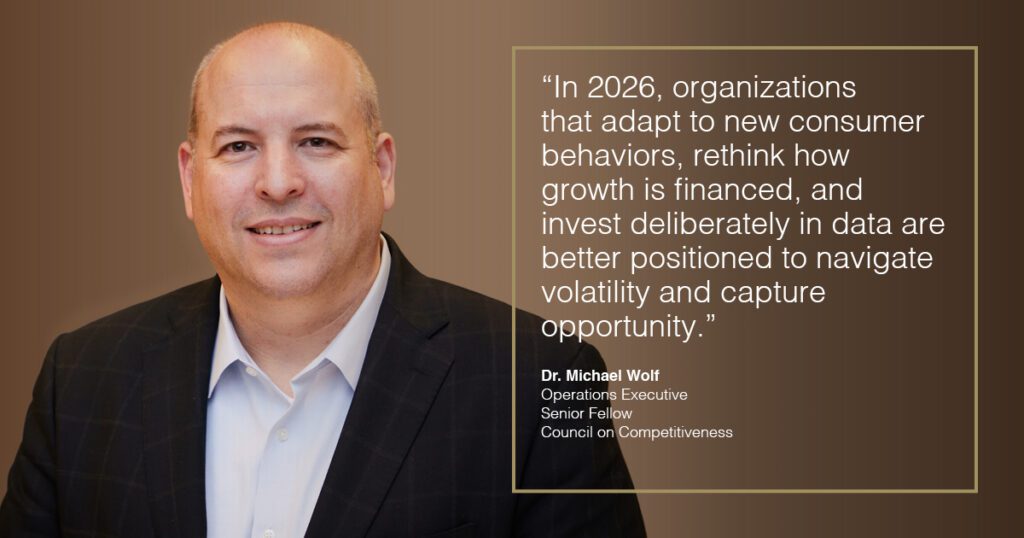
In a period defined by uncertainty, competitive advantage can be built by reimagining and executing on an organization's operating fundamentals. Organizations that adapt to new customer behaviors, rethink how growth is financed, and invest deliberately in data, are better positioned to navigate volatility and capture opportunity. This is not a retreat to conservatism; it is executing with discipline. The organizations that emerge strongest from the current environment will be those that recognize these realities early — and act on them decisively. In uncertain times, mastery of the fundamentals is not defensive; it is a competitive strategy.
About the Author
Dr. Michael E. Wolf is an operations executive and Senior Fellow of the U.S. Council on Competitiveness. His career includes senior leadership roles across the health, defense, aerospace, and technology sectors. He has served as an officer in the U.S. Navy and held executive positions at Mayo Clinic and the Hevolution Foundation, among other organizations. Michael resides in Los Angeles, California, with his family and can be reached at [email protected].
Bibliography
1. Federal Reserve Board. Financial Accounts of the United States (Z.1). https://www.federalreserve.gov/releases/z1
2. UN Conference on Trade and Development (UNCTAD). World Investment Report 2024. https://unctad.org/publication/world-investment-report-2024
3. U.S. Census Bureau. Quarterly Retail E-Commerce Sales (2024–2025). https://www.census.gov/retail/ecommerce.html
4. Organisation for Economic Co-operation and Development (OECD). Initial Public Offerings: Trends and Policy Implications. https://www.oecd.org/finance/initial-public-offerings.htm
5. National Science Foundation, National Center for Science and Engineering Statistics (NCSES). U.S. Research and Development Funding Trends. https://ncses.nsf.gov/indicators/research-and-development-funding