
As AI technology rapidly advances, the United States faces increasingly complex competitiveness challenges, as demonstrated by these graphs.
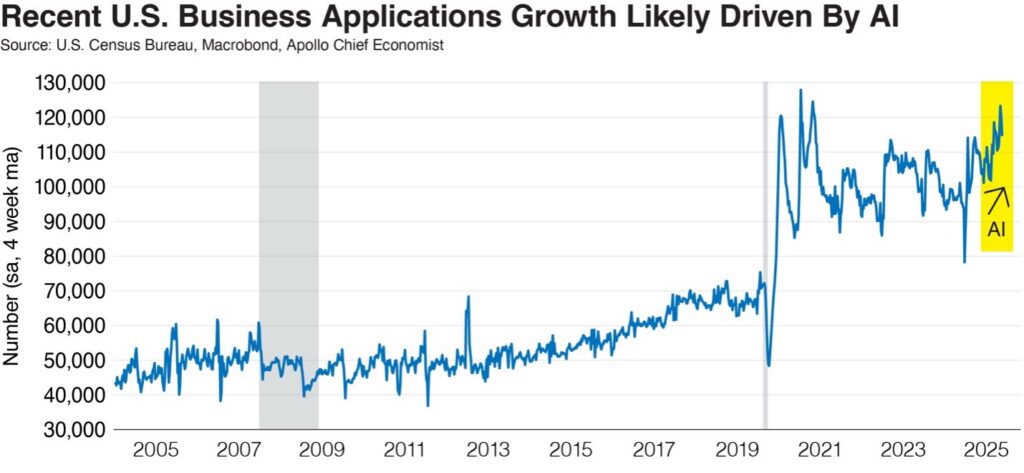
The first picture is optimistic. Weekly U.S. business applications have surged to historic highs, approaching 130,000applications per week in early 2026, according to data compiled by Apollo Global Management. For context, that figure is nearly double the pre-pandemic baseline and more than three times the lows recorded during the 2008 financial crisis. Apollo and others attribute this entrepreneurial explosion directly to AI and large language models, which are slashing the cost and complexity of starting a company to levels that would have been unimaginable a decade ago.
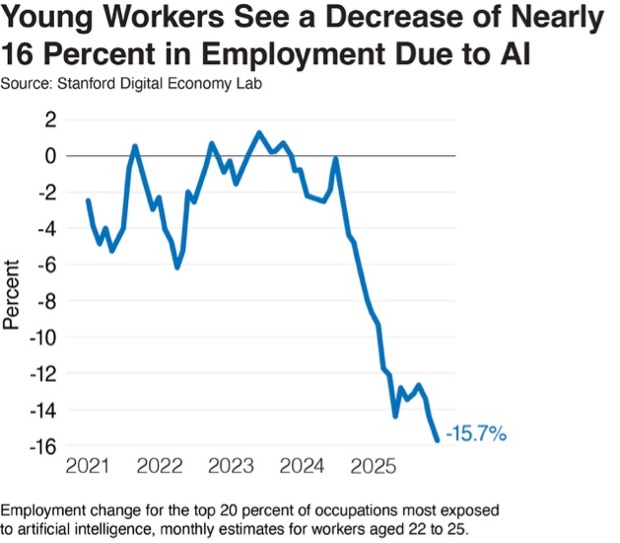
The second picture is far more sobering. Among workers aged 22 to 25 in occupations most exposed to AI, employment has fallen by nearly 16 percent in 2025. The Stanford Digital Economy Lab data, surfaced by researchers tracking AI's earliest labor market signals, suggests that the technology is not simply changing how young workers do their jobs. In many cases, it is eliminating the jobs — before those workers have had the chance to build the experience, skills, and networks that would allow them to adapt.
Taken together, these two charts illuminate a key competitiveness tension of the AI era: the same technology that is enabling a record wave of productivity gains and new business creation is simultaneously hollowing out the entry points through which the next generation of U.S. workers would traditionally build their skills to become tomorrow’s innovators, entrepreneurs, and business leaders.
A key question to wrestle with is whether the productivity gains unlocked by AI are being matched by investments in the people they will affect. Are our educational pathways and policy frameworks prepared to address what these two charts suggest—a structural discontinuity at a scale not seen in recent innovation cycles?
The Maryland edition of the Competitiveness Conversations Across America, "Unlocking American Innovation in the AI and Quantum Era," co-hosted this month with Morgan State University and University of Maryland, College Park, focused on advancing ideas to tackle these challenges. Look for the summary report of the event to be published soon.