
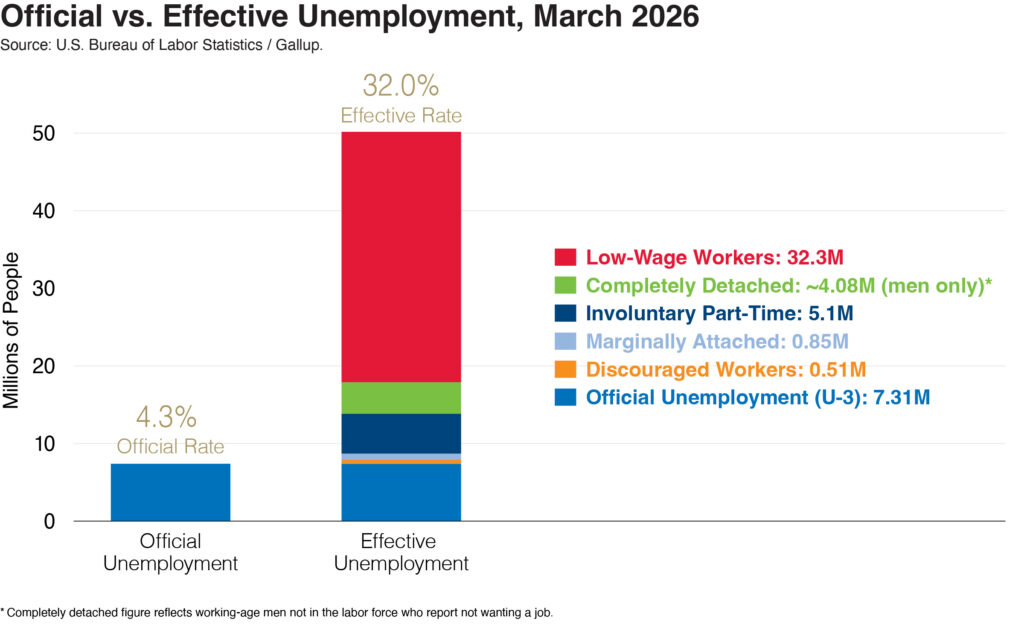
During the Council's Summer 2026 Board, Executive Committee, and National Commission Meeting, Gallup Chairman and Council Executive Committee Member Jim Clifton opened the day with a challenge to the standard framing of U.S. economic health.
The 4.3 percent official unemployment rate reported that morning, he argued, excludes a vast number of Americans who are, effectively, unemployed: discouraged workers, those marginally attached to the labor force, involuntary part-time workers, working-aged men who have left the workforce entirely, and workers earning less than a livable wage.
Gallup's survey-based methodology, drawing on 60,000 interviews per month, points to a figure closer to 54 million Americans, or 32 percent of the workforce, not fully engaged in productive employment.
The gap between 4.3 percent and 32 percent reflects a structural challenge at the heart of U.S. competitiveness: a workforce in which tens of millions of people are sidelined, underemployed, or locked in low-wage work that fails to capture their full productive potential. At a moment when the United States is competing globally for economic leadership, those 54 million people are not just a social concern; they are a competitive liability the United States cannot afford.