
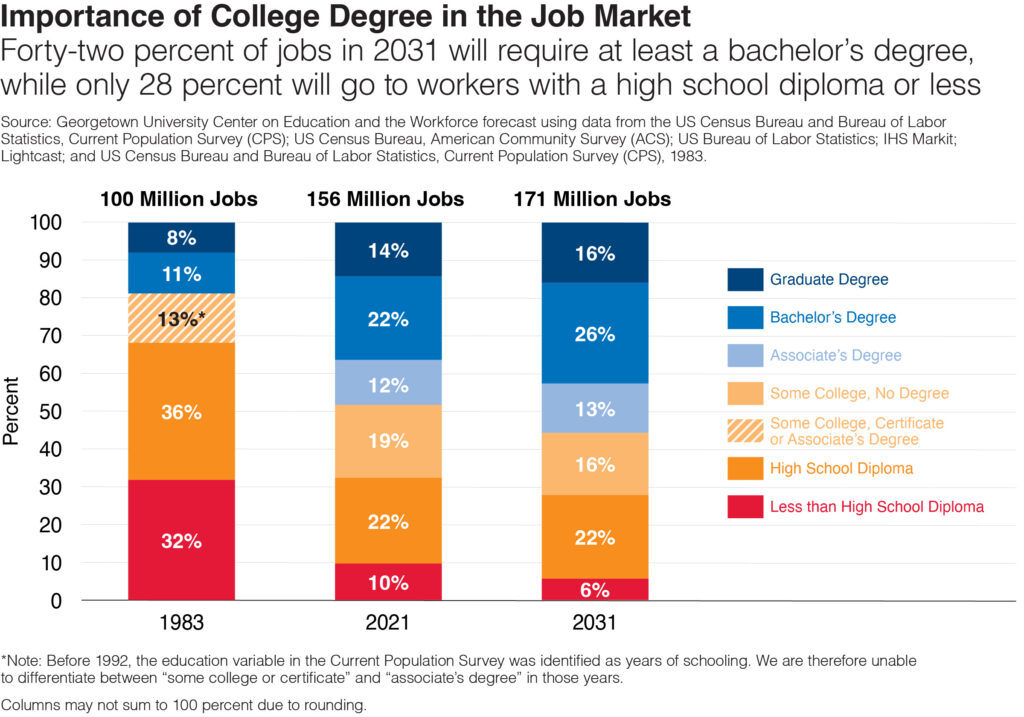
The U.S. job market is undergoing a fundamental transformation. In 1983, when the U.S. economy supported roughly 100 million jobs, most positions were accessible to workers with no education beyond high school. By 2031, as the economy grows to an estimated 171 million jobs, nearly three-quarters of all jobs will require some form of postsecondary education or training, including 42 percent requiring at least a bachelor's degree, according to Georgetown University's Center on Education and the Workforce. And the fastest-growing sectors — including healthcare, professional and business services, and advanced technology — are driving demand for workers with increasingly sophisticated skills and credentials.
From a competitiveness perspective, those nations that can produce, attract, and upskill talent will be best positioned to lead the next economy. Ensuring a robust pipeline of educated talent equipped for AI, advanced manufacturing, biotechnology, and other strategic industries is essential for sustained productivity growth. Read the full Georgetown CEW report here.