
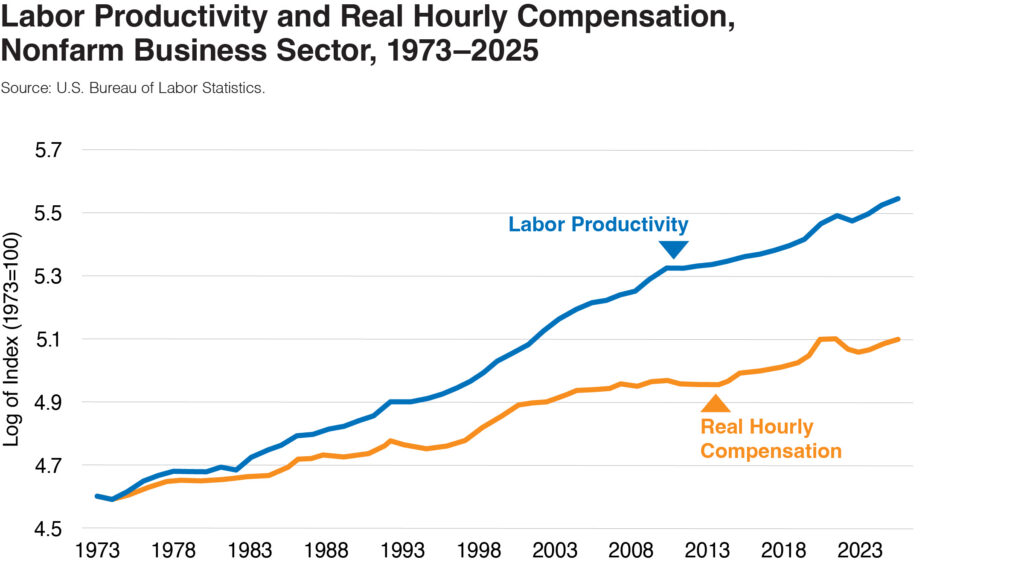
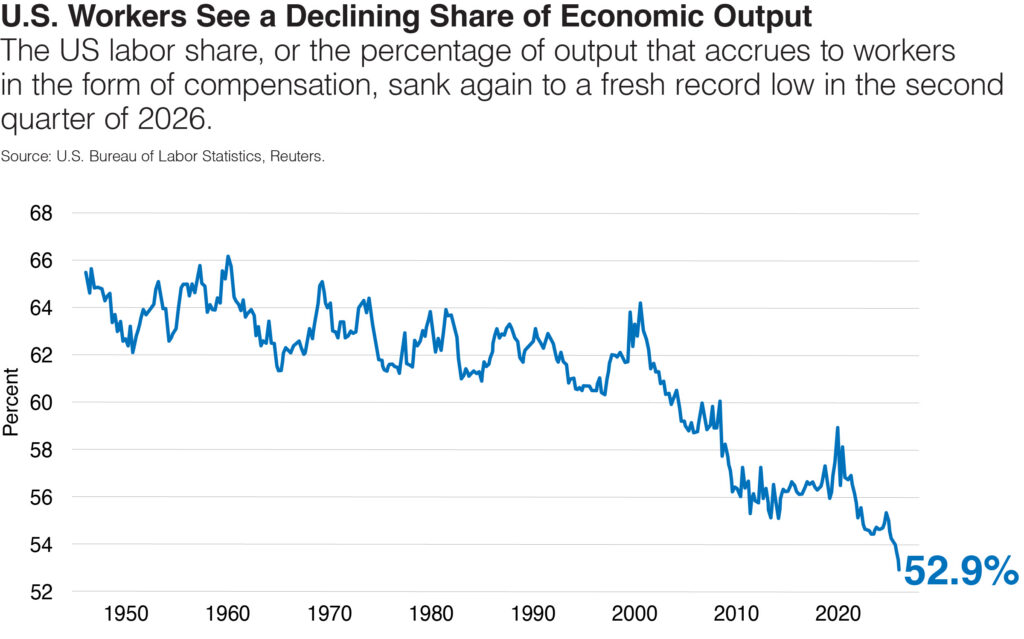
The Council is highlighting two related trends in the U.S. economy. For much of the modern era, rising productivity and compensation moved broadly together, helping drive higher living standards. Drawing on Bureau of Labor Statistics data since 1973, the first graphic shows the extraordinary gains in U.S. productive capacity over the past five decades alongside a growing divergence between productivity and real hourly compensation in the nonfarm business sector. The second highlights another dimension of this shift: in the second quarter of 2026, labor’s share of nominal GDP fell to a record-low 52.9 percent, even as productivity continued to grow.
These trends take on added significance as the United States enters another period of rapid technological change. As AI, advanced manufacturing, biotechnology, quantum technologies, and new forms of energy reshape the economy, the United States will need an ecosystem that can turn innovation into new businesses and industries, attract investment, build productive capacity, and expand opportunities for workers and communities. From entrepreneurship and capital formation to talent, manufacturing, regional innovation, and the policies that govern technology, our ability to turn invention into investment, investment into productive capacity, and productivity into opportunity will be critical to both U.S. competitiveness and broad-based prosperity.