
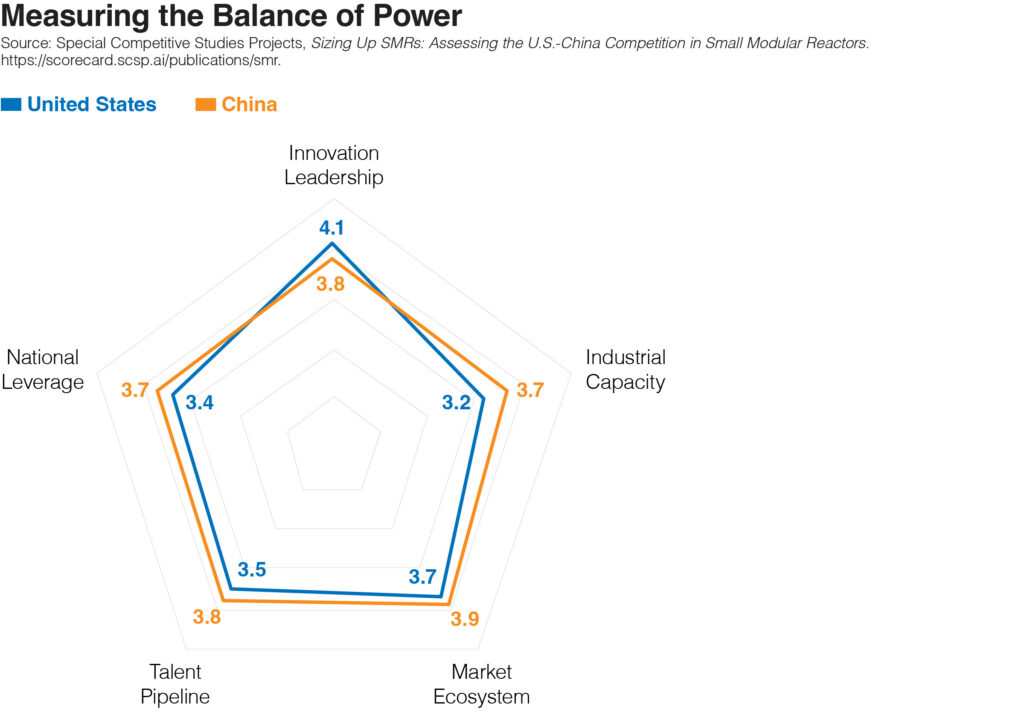
The U.S.-China competition in small modular reactors reveals a broader challenge for U.S. competitiveness: turning technological leadership into industrial capacity and deployment at scale.
A study from the Special Competitive Studies Project (SCSP), Sizing Up SMRs: Assessing the U.S.-China Competition in Small Modular Reactors, illustrates the challenge. The United States has more than 10,000 SMR-related patents, compared with 106 in China. Yet China leads in four other dimensions critical for competitiveness: industrial capacity, market ecosystem, talent pipeline, and national leverage. And most important, China has brought an SMR into commercial operation, while no U.S. commercial SMR is nearing completion.
This innovation-to-commercialization challenge extends well beyond nuclear energy in the United Sates. Too often, technological leadership outpaces the manufacturing capacity, skilled workforce, supply chains, and investment needed to bring innovations to market at scale. The United States retains formidable advantages in entrepreneurial innovation, research, private-sector demand, and global talent. The imperative is to align these strengths with the industrial capabilities and investment needed to translate technological advances into productive capacity.