
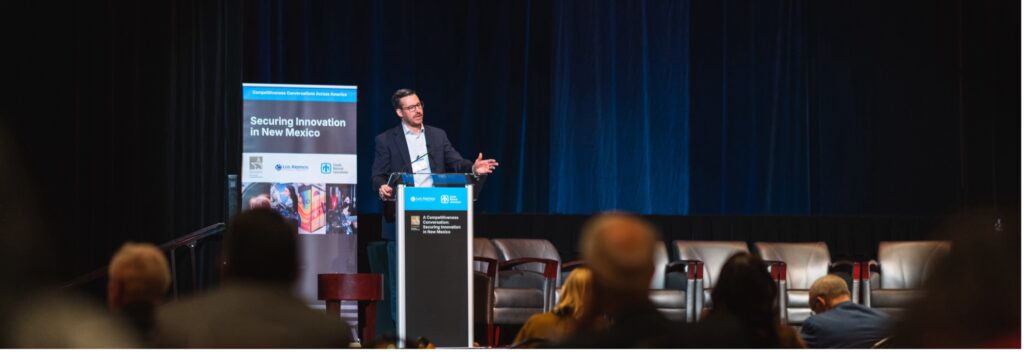
Dr. Dan Stick presented a comprehensive overview of the current state and future trajectory of quantum computing. In his Tech Talk, he outlined the critical roles played by universities, U.S. Department of Energy National Laboratories, and industry in developing the emerging field of quantum computing.
Dr. Dan Stick, Senior Scientist at Sandia National Laboratories, offered an in-depth perspective on the evolving landscape of quantum computing. He began by framing quantum computing as the “wild west” — a domain of science marked by unpredictable discoveries and multiple potential paths to success. Breakthroughs in the field often generate significant excitement but also demand careful scrutiny. While quantum systems are frequently touted as capable of solving virtually any problem by evaluating all possible solutions simultaneously, Dr. Stick cautioned that this portrayal can be misleading. The real challenge lies in designing algorithms that can effectively isolate and enhance the correct answer.
Recognizing the complexity of these challenges, Dr. Stick then outlined the institutional collaboration needed to advance the field. Universities, he explained, lead in conducting fundamental physics research, training students, and exploring diverse scientific directions in quantum. They are also critical drivers of innovation, frequently spinning off new companies. The U.S. DOE National Laboratories contribute by focusing on applied research tied to national missions, developing algorithms for government-specific challenges, and offering access to advanced facilities. Industry complements these efforts with targeted development efforts and commercialization strategies, driven by customer demand and investor expectations. “The successful development of a quantum computer will happen if people are pushing it from all directions,” Dr. Stick asserted, calling attention to the synergistic power of cross-sector partnerships.
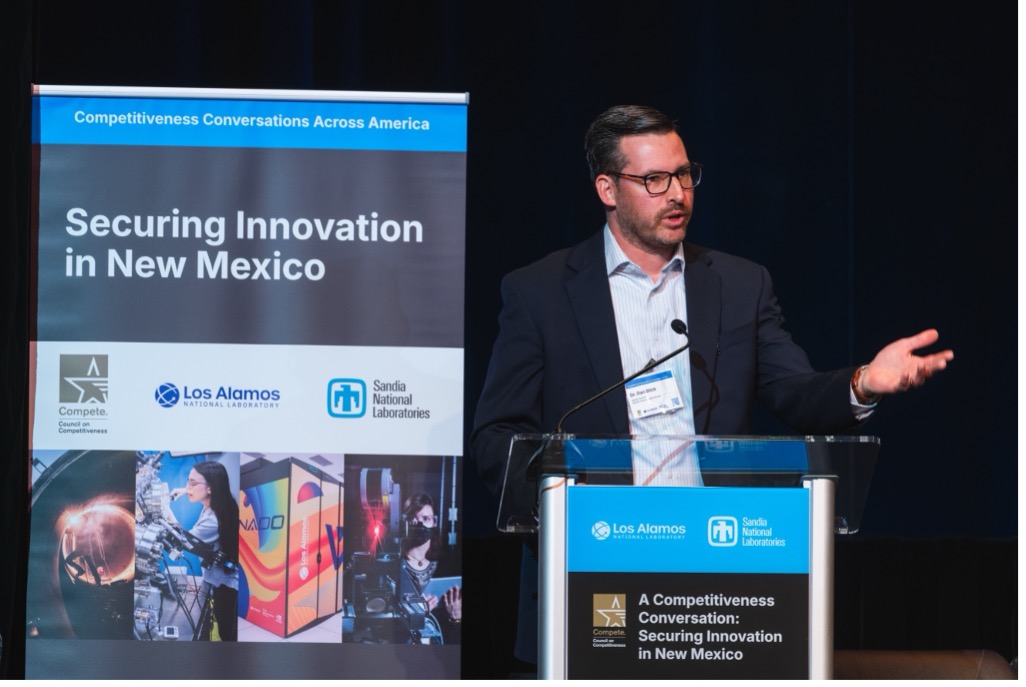
“Academic, national lab, and commercial researchers are working simultaneously to reduce the algorithmic resources required for useful quantum computation and to build more powerful quantum hardware to run those algorithms. When those two efforts meet, we will have a revolutionary computational tool.”
Dr. Dan Stick
Senior Scientist
Sandia National Laboratories
To illustrate how collaboration is already reshaping what is possible, Dr. Stick pointed to a case study involving FeMoCo, a molecule essential to nitrogen fixation and fertilizer production. In 2016, simulating this molecule using quantum methods was estimated to require over 100 million physical qubits and four days of computation. By 2021, a collaboration among universities, U.S. DOE National Laboratories, and private firms had reduced that requirement to just 4 million qubits, maintaining the same runtime — a leap that redefined the technical frontier and pulled forward the timeframe in which a system capable of performing this algorithm would be available. Other examples of collaborations accelerating quantum research are the DOE testbeds that provide low-level access to quantum hardware, enabling researchers to experiment with algorithms and conduct hands-on testing. These platforms — along with benchmarking tools and quantum tomography — help cultivate a competitive and creative research environment.
As Dr. Stick looked to the broader horizon, he made the case for sustained federal involvement to support breakthroughs that lie beyond the typical planning cycles of private industry. To illustrate the challenge and need for breakthroughs, he drew a comparison between current server chips, which contain 48 billion transistors and 5,000 I/O pins, and the projected demands of trapped ion quantum computers, which could require one million ions controlled by four million precision laser beams. Reaching that scale will require government-backed research to mitigate risks and pave the way for future commercialization.
Public investments are advancing the quantum field at both national and state levels. Federally, key efforts include the DOE’s National Quantum Information Science Centers, the NSF’s National Quantum Virtual Lab, and DARPA’s Quantum Benchmarking Initiative — which is evaluating the prospect that a utility-scale quantum computer will be operating by 2033. In New Mexico, the state is committing $30 million in 2026 to infrastructure, entrepreneurial ecosystems, and commercialization support. The University of New Mexico will also receive $1.8 million to expand its quantum institute, including $500,000 for first-year fellowships to support student and faculty research.
Through a careful balance of theoretical inquiry, applied experimentation, and multi-sector collaboration, New Mexico is establishing itself as a hub for quantum innovation. The trajectory of the field will not be defined by any single institution, but rather by the collective effort of universities, the U.S. DOE National Laboratories, and private industry working in unison to push the boundaries of what is possible.