
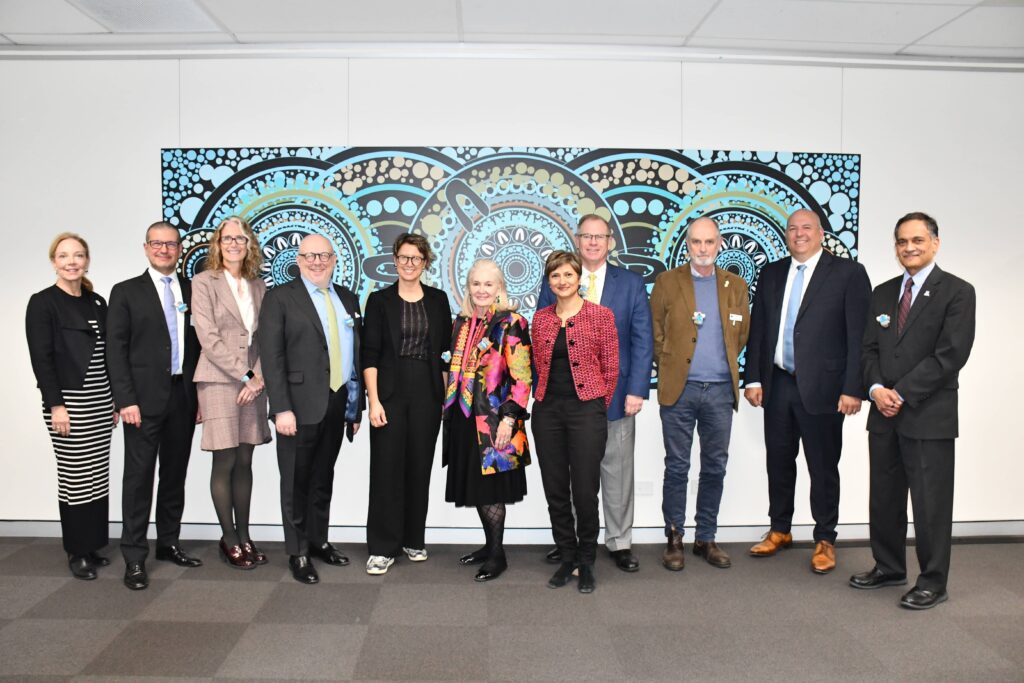
Photo Credit: ATSE
Left to right: Mrs. Anne Lingafelter, Principal Workplace Advisory, Gallup; Dr. Roberto Alvarez, Executive Director, GFCC; Dr. Kate Evans, Director Office of Institutional Strategic Planning, Oak Ridge National Laboratory; Mr. Chad Evans, Executive Vice President and Chief Operating Officer, Council on Competitiveness; Ms. Kylie Walker, Chief Executive Officer, ATSE; Ms. Prerana Mehta, CEO, ACOLA; Dr. Peter Dorhout, Vice President for Research, Iowa State University; ATSE representative; Dr. Michael Wolf, Senior Vice President, Hevolution; and Dr. Suresh Garimella, President, University of Arizona.
On July 22, the Council delegation the Council delegation joined a joint session with the Australian Academy of Technological Sciences and Engineering (ATSE) and the Australian Council of Learned Academies (ACOLA).
The meeting opened with a welcome and acknowledgment of Country by Ms. Prerana Mehta, CEO of ACOLA. Ms. Mehta introduced ACOLA’s mission as Australia’s leading forum for interdisciplinary collaboration and evidence-based policy advice, bringing together the nation’s five Learned Academies. She discussed ACOLA’s unique role in convening expertise across science, technology, health, humanities, and the social sciences to inform national policy, as well as its growing partnerships internationally, particularly with the United States.
Following Ms. Mehta’s welcome, the U.S. Council on Competitiveness provided a state-of-play briefing. The Council’s presentation outlined the organization’s mission to advance U.S. prosperity through competitiveness, innovation, and productivity. It highlighted the strategic drivers shaping United States innovation policy, including talent, technology, capital, sustainability, and security. Key findings from the Council’s Competing in the Next Economy report were shared, underscoring the importance of advanced computing, artificial intelligence, clean energy, and resilient supply chains. The briefing also stressed the importance of deepening international partnerships—particularly between the United States and Australia—in order to accelerate science, technology, and innovation outcomes.
A fascinating moderated discussion followed the institutional overviews, comparing the United States and Australian innovation ecosystems. While it was a wide-ranging conversation, several themes emerged: the need for increased federal R&D investment—something for which the Council consistently advocates—remains critical on both sides of the Pacific.
Dr. Kate Evans of Oak Ridge National Laboratory extended an invitation for collaboration with ATSE in advanced computing, while University of Arizona President Suresh Garimella discussed U.S. research funding dynamics, potential budget reversals, and the influence of immigration policies on attracting global talent. ACOLA leaders Dr. Lauren Palmer, Director of Policy and Projects, and Ms. Ramesha Perera, Engagement Manager, contributed insights on harnessing interdisciplinary research and stakeholder engagement to better translate science into actionable policy.
A discussion on nuclear energy revealed talent shortages, infrastructure gaps, and cost competitiveness issues in Australia, with Ms. Kylie Walker, CEO of ATSE, noting barriers and a CSIRO colleague citing the GenCost report’s projection that nuclear would be more expensive than renewables. Council Executive Vice President and COO Chad Evans closed the discussion by highlighting the Council’s role in educating U.S. lawmakers on science, technology, innovation, and research translation.
To conclude the session, Ms. Walker, offered closing remarks. She reiterated ATSE’s mission to provide trusted, independent advice on national priorities such as climate change, research translation, and talent development, and emphasized the Academy’s commitment to fostering international partnerships.
On the afternoon of August 21, the Council delegation visited the Australian Parliament House in Canberra, gaining a comprehensive overview of Australia’s legislative system and the role Parliament plays in shaping national policy, innovation, and economic strategy. The delegation engaged with leaders from both the House of Representatives and the Senate, exploring the intersection of policy, research, and national competitiveness.
These discussions offered delegates a high-level understanding of Australia’s legislative and policy landscape, with a focus on aligning government priorities with long-term economic growth, research commercialization, and technological advancement. Through these meetings, delegates gained insight into the role of parliamentary leadership in shaping policies that support innovation, competitiveness, and strategic collaboration.
The delegation concluded its first full day in Canberra with a dinner at The Boat House, hosted by Mr. Charles Kiefel AM. The evening provided a reflective and collegial environment for delegates to discuss insights from the day’s meetings, including engagements at the Australian Parliament and strategic discussions with innovation and industry leaders.
The dinner also featured prominent leaders from Australia’s nuclear and research sectors, including:
Their contributions underscored the intersection of advanced technology, national research priorities, and industry innovation, particularly in areas such as nuclear science, energy, and digital infrastructure.
Throughout the evening, delegates reflected on opportunities for collaboration across sectors, noting parallels between U.S. and Australian innovation ecosystems and the role of government and industry partnerships in accelerating research commercialization. The dinner served as a capstone to the day’s engagements, reinforcing connections among policymakers, researchers, and industry leaders, and setting the stage for the delegation’s continued exploration of strategic innovation and competitiveness in Australia.
On the morning of July 23, the delegation participated in a U.S.–Australia Strategic Innovation Alliance Breakfast Meeting at the Commonwealth Club in Canberra. The breakfast brought together senior Australian parliamentarians and Council delegates for discussions on innovation, research collaboration, and economic strategy.
Attending parliamentarians included
The discussion highlighted shared U.S.–Australian priorities in research and innovation, workforce development, and strategic collaboration. Delegates and parliamentarians explored policies that foster domestic capabilities, attract global talent, and support sustainable economic growth across energy, defense, and technology sectors. This meeting provided delegates with an enriched understanding of Australia’s approach to national innovation policy, legislative priorities, and economic strategy.
On July 23, a sub-section of the Council delegation visited the Clean Energy Regulator (CER), Australia’s independent statutory authority responsible for implementing the nation’s primary climate change laws and emissions reduction programs. Established in 2012, the CER plays a central role in advancing Australia’s national emissions targets, including a 43 percent reduction below 2005 levels by 2030 and achieving net-zero emissions by 2050. The agency administers a suite of legislation and market-based mechanisms, such as the Australian Carbon Credit Unit (ACCU) scheme, the Safeguard Mechanism, the Renewable Energy Target, the National Greenhouse and Energy Reporting scheme, and the Guarantee of Origin scheme. More recently, the CER has taken on the Nature Repair Market, issuing tradable certificates for projects that restore biodiversity under the Nature Repair Act 2023.
During the visit, delegates met with several leaders in the resources and energy fields.
Through these engagements, the delegation gained a high-level understanding of how Australia’s government, regulatory bodies, and industry coordinate to advance energy, climate, and resource priorities, and how innovation and policy intersect to support sustainable economic growth and competitiveness.
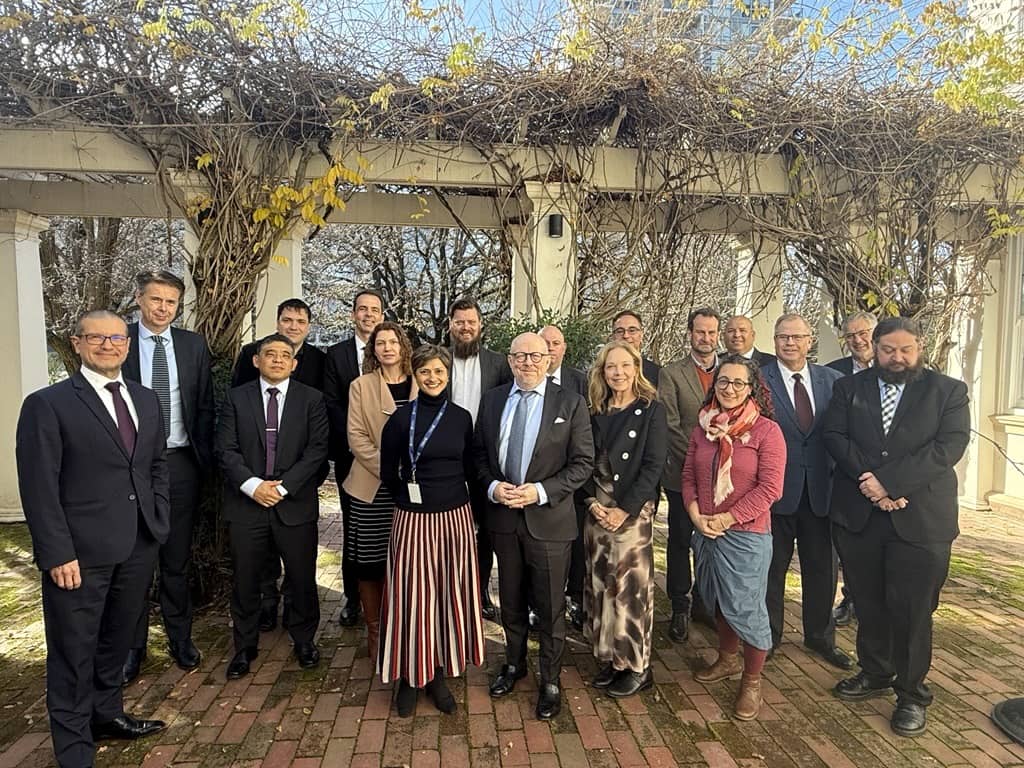
Photo Credit: ACOLA
Left to right: Dr. Roberto Alvarez, Executive Director, GFCC; Professor Anton Van Den Hengel, Director, Centre for Augmented Reasoning -and- Director, Australian Institute for Machine Learning, Division of Research and Innovation, University of Adelaide; ACOLA Representative; ACOLA Representative; ACOLA Representative; Ms. Prerana Mehta, CEO, ACOLA; Mr. Chad Evans, Executive Vice President and Chief Operating Officer; Mr. Alec Webb, Chief Executive Officer, Regional Universities Network (RUN); Mrs. Anne Lingafelter, Principal Workplace Advisory, Gallup; Dr. Philip Chindamo, Chief Economist, Group of Eight; Professor Kent Anderson Interim Executive Director, Australian Technology Network of Universities; ACOLA Representative; Dr. Michael Wolf, Senior Vice President, Hevolution; Dr. Peter Dorhout, Vice President for Research, Iowa State University; ACOLA Representative; and ACOLA Representative.
On the same day, the other sub-section of the delegation participated in a roundtable discussion with the Australian Council of Learned Academies (ACOLA). The session brought together leaders from across Australia’s research ecosystem, including representatives from the Group of Eight universities, the Australian Technology Network, the Regional Universities Network, and several government and industry bodies.
Hosted by Prerana Mehta, ACOLA's CEO, the conversation examined Australia’s fragmented research funding—spread across roughly 150 programs—and its limited success in commercialization. While the primary mechanism for government R&D support remains the tax incentive program, additional creative solutions are currently under review. Participants highlighted four major opportunity areas:
Discussion coalesced around three themes:
Productivity – The absence of scientific perspective and research from the government’s productivity roundtable. For example, participants argued that the Treasury’s prevailing view prioritizes the adoption of overseas innovations rather than building domestic technology capabilities, which may limit Australia's long-term competitiveness.
Research Commercialization – Australia's need to capture its research investments for long-term, sustained economic growth. The Israeli model of leveraging agricultural research institutes to spur industry growth was cited as a successful example.
Sovereign Capabilities – Participants discussed the perceived capability erosion happening in Australia, citing the loss of solar panel manufacturing to China as evidence. What's holding Australia back? Participants suggested three primary culprits, including low private-sector R&D investment, underutilized superannuation funds for innovation, and challenges in attracting and retaining talent.
In the afternoon of July 23, the delegation united with Australian National University (ANU) and its Advanced Instrumentation and Technology Centre, located at the site of the university’s historic Mount Stromlo Observatory.
Established in 1968, ANU remains home to Australia’s only stand-alone astronomy department and has evolved from producing in-house instruments for research to delivering complex systems for global clients, including space and ground-based telescopes.
Today, the university’s expertise extends into laser technologies and quantum-encrypted telecommunications. The instrumentation program operates as a quasi-commercial venture, with design and engineering anchored at ANU, while much of the manufacturing is carried out in China to reduce costs.
The delegation toured the National Space Test Facility, a shared-use infrastructure equipped with vacuum and anechoic chambers for simulating outer space conditions—used by Australian companies to test satellites and space systems. With project values ranging from USD $20 million to USD $50 million and a pipeline exceeding USD $100 million, ANU blends academic research, professional engineering, and commercialization, supported by a strong base of PhD students and postdoctoral researchers.